Google Ads Stopped Rewarding the Best Bidder. It Rewards the Best Data.
 Daniel Sorenson
The short version
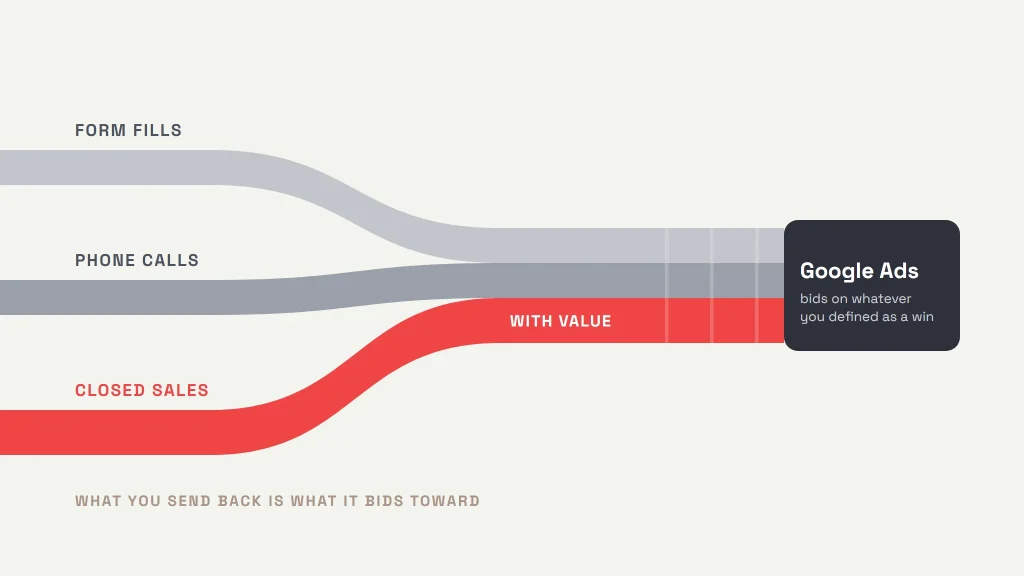
- Google removed nearly every manual control over the last five years. The one input it left you is the definition of success you hand it — which makes conversion data the whole game.
- Most accounts track leads and calls correctly and stop there: no values assigned, no separation between a lead you can use and one you can’t, and often the same lead counted twice.
- Separating one kind of form submission from another moved a client’s account more than any campaign change did — and it needed no data pipeline at all.
- Performance Max is worth running once Google knows what a good lead looks like for you. Google’s own documentation says to optimize toward a qualified lead, not a form fill, and that value-based bidding needs two or more different values.
- Closing the loop means sending closed sales back — click identifier into your CRM, outcome back to Google. Below Google’s eligibility threshold for conversion modeling, 700 ad clicks a week, your own data is the only data you have.
- If you don’t know what a lead is worth, back into it from revenue and margin. The estimate is enough, and building it is worth more than the number.
Google Ads spent the last five years taking away the controls. You used to write the ad, choose the attribution model, and set the bid — the system does all three now, and this year it started choosing the landing page too.
Be clear about what that means for the money. The bid is the price you pay for a click, and Google sets it now. Google is also the company being paid for that click. That isn’t a scandal — it’s how the auction has always worked, and the system genuinely does price a click better than a person adjusting bids by hand on a Tuesday afternoon. But the last direct lever you had over what a click costs you now sits with the party selling it, and the only thing you still tell it is what a good outcome looks like.
Performance Max hands over more of that control than any other campaign type, which is what makes this a real decision rather than a settings change:
“Should we be running Performance Max? That seems to be where Google wants the spend.”
Yes, eventually. Not until Google knows which of your leads are actually worth having — because until it does, you’re paying it to go find you more of your worst ones.
Take those controls one at a time. In June 2022 Google ended the ability to create or edit expanded text ads, and responsive search ads became the only kind you could build in a standard search campaign.1 Six attribution models — the setting that decides which click gets credit for a sale — became two.2 Bidding moved to the system, which now sets it in every individual auction. And this year, Google’s newest search product started writing the ad copy and picking which page on your site to send the click to.3
Google’s reason for all of it is a good one, and it’s worth stating fairly before disagreeing with any part of it: about 15% of the searches people run every day are searches Google has never seen before.1 Nobody manages that by hand. Automation isn’t Google being greedy. It’s Google being correct about scale.
But look at what got removed. Every one of those controls was a way of telling the system how to buy. None of them was ever the thing that decided whether the buying was any good. That was always the definition of success you handed it — and that’s the one input Google didn’t take away. It made it the only one that matters.
The first thing I look at is the conversion actions, not the campaigns
Auditing an existing account always comes before managing it, and usually before we’ve even scoped what managing it would involve. Google Ads moves quickly, expertise in it varies a lot, and there are enough settings and structural decisions inside an account that more than a few of them typically need to be revised, rebuilt, or in some cases created for the first time.
Conversion actions are where I start. That’s the part of the account defining what counts as a win — a form, a phone call, a purchase. And they’re usually fine as far as they go. Leads tracked, calls tracked, set up correctly. What’s almost always missing is any depth underneath that. Most commonly there’s no value assigned to any of it. Every lead worth the same as every other lead, which is another way of saying the account has no idea what it’s aiming at.
The bigger miss sits one level further down, in the form itself. Either the form doesn’t ask the question that would tell you this lead is worth more than that one, or it does ask it and nobody set up tracking for those submissions separately from the general “someone filled out the form” event.
That distinction sounds small. Here’s what it was worth.
One client, two kinds of applicant, one conversion action
We work with a transportation company that recruits team drivers — two drivers running a truck together. That’s the hire they need. Their form, though, can be filled out by anyone, including solo drivers, who are perfectly good people to hear from and not people this business can put to work.
Every one of those submissions was landing in Google Ads as the same conversion. So Google, working exactly as designed, went and found more people who fill out that form. It had no way of knowing that a large share of them were unhireable, because nobody had ever told it.
What we did was tag the team driver submission separately from the solo driver submission, and then use only the team submission as the primary conversion feeding the bidding strategy.
The progression after that is the part worth taking away. First lead volume improved. Then the mix improved — the share of submissions coming from team drivers climbed and solo submissions fell off, which meant more of the same budget went toward drivers they could actually hire. That second move came from conversion tracking changes alone. No new creative, no new targeting, no bigger budget.
Notice what it didn’t require. There’s no pipeline running from their applicant tracking system back into Google here. A full closed-sale loop is the best version of this and I’ll get to it, but the team submission is a strong enough indicator on its own that the simpler build still drove a significant improvement. The depth has to match the business, not some ideal.
That account has been with us long enough that the tracking has been revised repeatedly as Google changed underneath it. Moving off manual cost-per-click bidding onto an automated strategy was a significant improvement by itself. Adding the separated team submissions and conversion values on top of that drove further improvement again.
Fixing duplicate conversions will make your reporting look worse
Here’s the genuinely uncomfortable part of this work, and I’d rather say it than have you find out from a dashboard.
When we clean up an account with duplicate conversion events — the same lead counted twice, usually because tracking got set up two different ways and nobody removed the first one — the reporting changes immediately. Your cost per lead doubles. Not because anything got worse. Because you were dividing your spend by an inflated lead count, and now you’re dividing it by the real one.
For a month or two it looks like we’re failing. We aren’t. We’re fixing the foundation every optimization after this one depends on. But somebody has to explain that to a client, and explaining a data problem to a business owner watching a number get worse is harder than any of the technical work involved.
Related, and worth checking in your own account: how was your tracking set up in the first place? Google Analytics events are extremely common, mostly because they’re the easiest thing to configure. Whenever I see that an account took the easiest available route to tracking, I know to look harder at everything else in the settings — the two tend to travel together. Setting tracking up properly the first time takes longer, and from that point on the same budget goes further. That’s the trade.
What is a lead actually worth?
This is where most of these conversations stall, so here’s the version that works.
Almost no client knows this number precisely. Most have a decent sense of their close rate. Where it gets complicated is close rate by source, which is usually not clear at all.
Start with what it costs you to acquire a customer, and if you sell several different services or products, work out where that number differs between them. If you don’t have a reasonably solid acquisition cost, back into it. Start with average revenue per customer, or extend that to lifetime value if repeat business is a real part of your model.
And you do know revenue per customer. Every business does. You also know your margins. Revenue and margin together give you an acceptable acquisition cost, and your close rate estimate turns that into what you can afford to pay for a lead. Those are estimates. Estimates are enough to start.
Now the part that surprises people. Even when a client does have these numbers precisely at the moment we ask, they change. So the estimate isn’t a poor substitute for the real figure — backing into it is the more valuable exercise either way, because it hands the business a framework to operate against and measure against.
Once that framework exists, other things start getting measured almost as a side effect. Website conversion rate. Sales team effectiveness. Attribution. Each of those raises what the business actually knows about itself, which changes how it operates, which improves results in ways that reach well past anything you can do inside an ad account. That’s the honest reason we spend time here instead of only applying campaign best practices — the campaign work is the smaller half of the return. It’s also, plainly, why the company is named what it is.
So where does Performance Max fit?
I’d put it this way: Performance Max matters less than defining what a qualified lead is and tracking it properly. That’s a ranking, not a dismissal, and the difference matters — plenty of people have written Performance Max off entirely.
It can be very impactful. It drives meaningful results and it’s a real opportunity to grow Google Ads spend productively alongside search campaigns. But all of that hinges on lead qualification, tracking implementation, and the pipelines feeding them. Give it clean conversion data and it performs. Give two businesses the same campaign and different data quality, and Performance Max widens the gap between them rather than closing it.
It’s also worth saying that the campaign type has improved, because a lot of what people “know” about Performance Max dates from its first two years. Advertisers can now add negative keywords at campaign level directly instead of emailing a spreadsheet to a Google rep, exclude placements and networks, restrict devices and dayparts, and exclude customer lists to push spend toward new customers.4 Notice the direction of every one of those, though. They’re reporting and exclusion controls. Google is giving you better visibility and better ways to say no. It is not giving back the bid.
Google says roughly the same thing I’m saying in its own documentation, which is the part almost nobody acts on. For lead generation it recommends optimizing toward conversion goals like “qualified lead” or “converted lead” rather than raw form submissions, and notes that choosing those goals switches on invalid traffic protections built specifically for lead gen. It also recommends reCAPTCHA, double opt-in, or server-side validation to keep junk out.5
The bidding documentation is more direct about the prerequisite. Value-based bidding — where you tell Google what outcomes are worth and it bids toward value instead of volume — requires you to report two or more different values. Not values in general. Different ones. A business sending one flat conversion for every form fill is, by Google’s own definition, not really in a position to use the strategy. Target ROAS, the strategy that chases return on ad spend, also expects at least 15 conversions in the past 30 days before it has enough to work with.6
There’s a timing requirement people miss too. Google recommends reporting a conversion within about seven days of the click, and warns that when outcomes take longer than that to come back, the bidding can take several months to ramp up.6 If you have a long sales cycle, that isn’t housekeeping. It’s the difference between a strategy that learns and one that never quite does.
So ask this about your own account: what did you tell Google a conversion was, and would you spend your own money buying more of exactly that?
Sending your closed sales back to Google
Closed-sale data is the best data you can send back to an ad platform. There’s no close second, and building the pipeline to do it is the right answer, hands down.
The mechanics are less exotic than they sound. Every ad click carries an identifier, which Google calls a GCLID. You capture it along with the lead, store it in your CRM against that person’s record, and when the deal closes you send it back with the outcome attached. Google’s newer version of this, enhanced conversions for leads, adds scrambled customer details from your form to improve how often the match succeeds. That scrambling matters for the obvious objection: the customer data is hashed before it leaves your side, and Google matches on the hashed version rather than the real one.7
If you’re on a mainstream CRM this is closer to a configuration job than a build — Google’s Data Manager connects to a number of common platforms directly, without a third-party integration in the middle.8 The obstacle usually isn’t the plumbing. It’s that nobody has decided what a qualified lead is, or made sure the sales team records it the same way twice.
Data Manager is also where this is heading. In June 2026 Google moved offline conversion imports and enhanced conversions for leads onto the Data Manager API and blocked those uploads in the older Google Ads API.9 The practice didn’t change, only the route — and if you work in the Google Ads interface or through a standard connector, nothing was asked of you. If someone built you a custom integration, it’s worth asking them which API it writes to.
That’s the less obvious argument for treating these pipelines as systems rather than as tracking. When a platform changes how the data moves, you find out because you’re already working in it, not because a feed went quiet six weeks ago.
Is a full closed-sale loop always strictly necessary? No. If there’s a clear enough difference in intent between two kinds of lead — as with the team drivers — scoring can bridge part of the gap. But be honest about the effort involved: getting that scoring right is roughly the same amount of work as auto-tagging your clicks, pulling the identifier into the CRM, and scheduling a recurring export of closed sales back to Google.
What about a business with no usable CRM at all? We’ve gotten creative. A Google Sheet holding lead data with the click identifier, with the business updating it as leads turn into sales, genuinely works. It’s manual, it invites errors, and it lives or dies on whether anyone actually maintains it — but if they do, the result isn’t very different.
I wouldn’t recommend that to a client. We’ve handed it to plenty of businesses anyway, in conversations where the fit wasn’t there and there was no engagement at the end of it. We talk to a lot of companies about their data, and if someone can make progress on a spreadsheet, they should have the spreadsheet.
The 700-click threshold nobody mentions
One more thing worth knowing, because it quietly determines which options are even open to you.
When a visitor declines cookies, Google can estimate the conversions it wasn’t able to observe directly. That modeling is real and it works. But there’s an eligibility floor: consent mode implemented correctly, plus 700 ad clicks over seven days for a given country and domain.10 That’s roughly a hundred clicks a day.
A lot of smaller advertisers aren’t there. If you’re below it, the modeling isn’t quietly filling in your gaps — which means your own first-party data isn’t one option among several. It’s the only one you have.
We don’t find that limiting, but only because the answer to sitting under a threshold is knowing how to scale an account up to it and unlock the automation on the other side. That’s a plan, not a setting.
Then what is an agency for now?
Fair question, and the honest answer isn’t the flattering one.
The tools genuinely are getting easier to use — specifically and most importantly, when they’re used properly. Automation and AI have absorbed a real amount of the execution across ads, websites, and design. If what someone was selling you was execution, a lot of that value has moved into the platform, and it isn’t coming back.
What automation hasn’t absorbed is knowing how the pieces connect. The form field that determines the lead score. The tracking that separates one submission from another. The identifier that follows a click into your CRM. The closed sale that goes back out. The bidding strategy that finally has something true to optimize toward. The margin math saying what any of it is worth. Every one of those lives in a different system, and mostly in a different person’s job description. Anyone who understands how they interlock and can execute against a plan for using them is positioned to make a substantially larger impact than was possible before automation. The leverage went up, not down.
That’s the actual shift, and it’s the same one running underneath AI search: automation didn’t reduce the work, it moved the work upstream — out of the ad account and into the data underneath it. Which happens to be the layer that, in most businesses, nobody owns.
Where to start
Open your conversion actions and read them like a stranger. Is there a value on each one? Are two of them counting the same event? Is a form fill worth the same as a booked appointment?
Find the question your form should be asking. The one whose answer separates a lead you want from a lead you don’t. Then tag that submission on its own.
Do the margin math even if it’s rough. Revenue per customer, margin, close rate. Estimates are enough. The framework is worth more than the precision.
Get the click identifier into your CRM. Even if the sales side isn’t ready to send outcomes back yet, start collecting it now. You can’t backfill it later.
Check what happens after the click, too. The best conversion data in the world still runs through your website, and a conversion audit usually turns up more than another round of campaign changes will.
Then talk about Performance Max. With a clean definition of a good lead feeding it, it’s an opportunity. Without one, it’s an efficient way to buy more of whatever you’re currently mislabeling as success.
Back to where we started. Should you run Performance Max? The question underneath it is the one worth answering first: does Google know what a good customer looks like for your business? If the answer you’ve given it is a form submission, you haven’t told it anything yet.
That’s a conversation worth having before you increase the budget, not after — and it’s the one we’d rather start with when we take on lead generation work.
Where this is going
One closing thought, and it’s a conclusion about my own company, so weigh it accordingly.
With respect to the continuing evolution of platforms like Google Ads, there’s an additional benefit to agencies who are deeply ingrained in the full funnel and in the system data pipelines for reasons more than just tracking: they’re also attuned to changes like Google’s move to the Data Manager API and the deprecation of the older offline conversion upload method. For Flywheel, these changes seem to continue to align with our approach to system integration and to create ease of doing so. For that reason we believe we’re better positioned than ever before in the complex and competitive market of digital marketing and technical solutions enabling client growth, from the developments we continue to accelerate internally as Flywheel Technology, available to our clients.
If you want a straight read on what your own account is actually telling Google, get in touch.
Sources
- Carolyn Lyden, Search Engine Land, August 31 2021, reporting Google’s announcement that from June 30 2022 advertisers could no longer create or edit expanded text ads, leaving responsive search ads as the only creatable search ad type in standard campaigns. Existing expanded text ads continued to serve and report. Google’s stated rationale, quoted in the same piece, is that 15% of daily search queries are ones it has never seen before. ↩↩
- Google Ads Help, about attribution models, accessed August 2026. First click, linear, time decay and position-based are no longer supported; last click and data-driven remain, with data-driven the default for most conversion actions. Conversion actions on the retired models were moved to data-driven automatically. ↩
- Google Ads blog, April 30 2026, on AI Max for Search generating ad copy and selecting landing pages automatically. Google publishes no performance figures in that announcement. Separately, Google is upgrading Dynamic Search Ads into AI Max — voluntarily now, automatically from September 2026, after which new Dynamic Search Ads campaigns can’t be created. ↩
- Sarah Vlietstra, Search Engine Land, March 26 2026, on campaign-level negative keywords, placement exclusions, ad scheduling, demographic exclusions and device controls. Customer list exclusions, budget forecasting, demographic reporting and network-segmented placement reports are covered by Danny Goodwin, Search Engine Land, same date. ↩
- Google Ads Help, best practices for generating high-quality leads, accessed August 2026. Google names “qualified lead,” “converted lead,” “book appointment” and “request quote” as lead generation conversion goals that activate invalid traffic protections, and recommends reCAPTCHA, double opt-in or server-side validation. It recommends value-based bidding where leads differ in value, and target cost-per-acquisition against a qualified-lead action where a business can’t assign distinct values. ↩
- Google Ads Help, Smart Bidding using value-based bidding for Search and Shopping, accessed August 2026. Google states target ROAS requires at least 15 conversions in the last 30 days, that value-based bidding requires reporting two or more different values (real revenue or proxy values such as lead scores), that it recommends a conversion delay under seven days, and that ramp-up can take several months where conversions aren’t uploaded until more than seven days after the click. ↩↩
- Google Ads Help, about enhanced conversions for leads, and Google Ads API, manage offline conversions. The API documentation covers GCLID capture from ad click URL parameters, and requires user-provided data to be normalized and SHA-256 hashed before upload, with up to five identifiers per conversion. ↩
- Google Ads Data Manager Help and its supported data sources list, which includes direct CRM and customer data platform connections that don’t require a third-party integration partner. Both accessed August 2026; the supported-source list changes without notice. ↩
- Google Ads Help, about offline conversion imports states that from June 15 2026, offline conversion imports and enhanced conversions for leads uploads move to the Data Manager API and are blocked in the Google Ads API. Announced on the Google Ads Developer Blog, May 15 2026. The block applies to developer tokens with no prior history of sending these uploads, so integrations already running were not cut off — it gates new builds on the legacy method. Google’s upgrade guide sets out the practical differences: no developer token, a different OAuth scope requiring new credentials, uploads sent from the account that owns the conversion action rather than from a parent or child account, and a fast-fail model in which one bad record fails the entire request. Advertisers working in the Google Ads interface or through Data Manager were migrated automatically where they had already accepted Google’s customer data terms. ↩
- Google Ads Help, about consent mode modeling, accessed August 2026. Eligibility requires consent mode or IAB TCF v2.0 implemented correctly, plus a threshold of 700 ad clicks over seven days per country and domain grouping. Google also notes that consented users are two to five times more likely to convert than unconsented users, and recommends cookieless pings so the modeling can be calibrated. ↩